
If you live with neuropathy or sciatica, you already know:
You may have been told:
“It’s progressive.”
“It’s microvascular damage.”
“It’s mitochondrial toxicity.”
“We can manage symptoms.”
But what if that model is incomplete?
A 2023 narrative review on diabetic neuropathy proposes something radical:
Rather than being irreversible damage, nerve pain may represent adaptive changes within the autonomic and neural control systems — meaning the condition may be modifiable and potentially reversible
Adaptive Controls in DPN
The review describes two core systems:
If these systems are adaptable… then neuropathy may not be a one-way decline.
It may be a nervous system that needs the right signal.
Unlike conventional TENS — which mainly blocks pain temporarily via gate control — high-frequency pulsed radiofrequency appears to stimulate restorative neural processes, not just symptom masking
TENS vs Transcutaneous Pulsed Radiofrequency
This is not simply pain gating.
This is neuromodulation.
A randomized, single-blind, placebo-controlled trial of 80 patients with pedal diabetic neuropathy found:
After just 3 treatments of pulsed radiofrequency:
This was not anecdotal.
It was controlled.
And importantly — improvements occurred after only three sessions.
Many patients with chronic neuropathic pain are placed on medications like gabapentin.
However, a 2025 observational study reported:.
While observational studies cannot prove causation, the findings raise serious questions about long-term reliance on suppressive medication strategies.
Patients deserve options that aim to restore function — not simply suppress nerve signalling.
The vagus nerve plays a major role in regulating inflammation via the Cholinergic Anti-Inflammatory Pathway.
Electrical stimulation of vagal pathways has been shown to reduce pro-inflammatory cytokines like TNF.
Cholinergic Anti-Inflammatory Pathway
Literature reviews on vagus nerve stimulation show:
Why does this matter?
Because chronic neuropathy is not just a peripheral problem.
It involves:
Neuromodulation addresses the system — not just the symptom.
Electrical stimulation has demonstrated the ability to promote neuroplastic changes and functional recovery following neurological injury
TBI-Motor-recovery
The nervous system is not static.
It reorganises in response to input.
If pain is a maladaptive pattern — then providing a corrective electrical signal may help shift the system out of chronic threat mode.
If neuropathy is purely degenerative, then management is all we can offer.
But if it is an adaptive nervous system stuck in maladaptive signalling…
Then targeted neuromodulation may offer something more.
And that possibility changes everything.
Next Step
Then the question becomes:
Is your nervous system ready for a different signal?
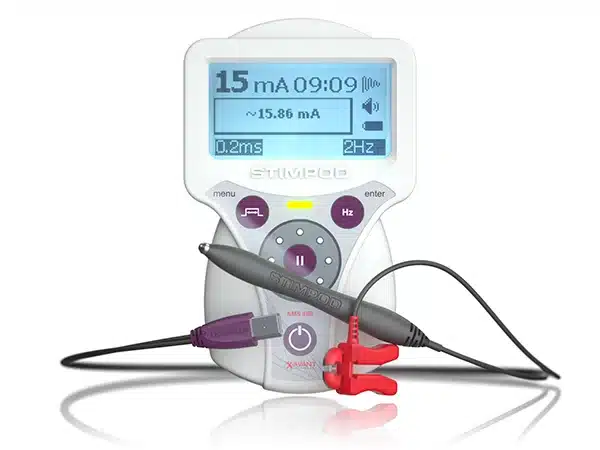
Book an assessment to explore whether Stimpod PRF is appropriate for you.
FAQs About Stimpod Therapy
While mechanisms are still being studied, pulsed radiofrequency is believed to:
It is:
Stimpod PRF may be appropriate for:
It is positioned as a restorative neuromodulation strategy.
Most protocols begin with:
In clinical trials, meaningful changes were observed after three treatments
But for patients who feel they’ve “tried everything,” this represents a different category of intervention.
Want to know more but not ready for a full assessment? Fill in the form below and we’ll be in contact shortly to arrange a free discovery visit – with no obligation.
Want to know more about how we can help you save upto £32,000 in hidden HR costs? Fill in the form below and we’ll be in contact shortly.